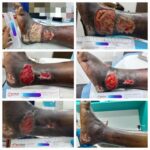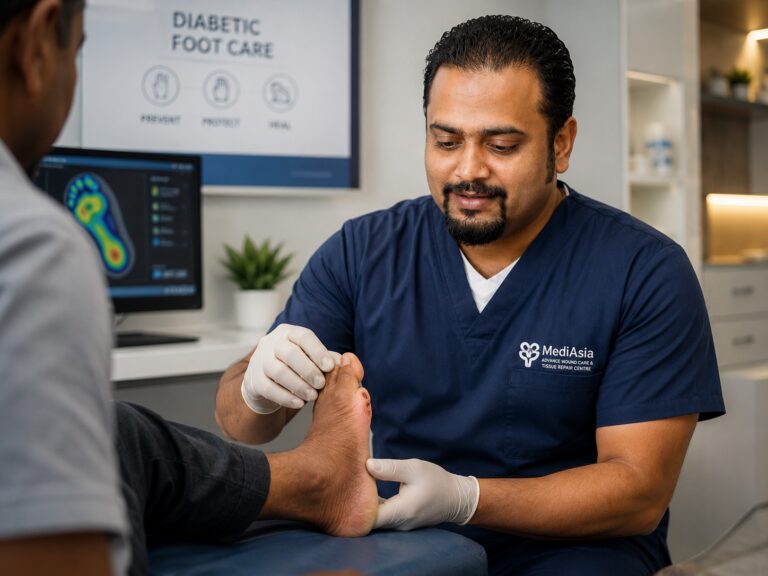


A diabetic foot ulcer may appear to be a problem located on one small part of the body.
In reality, the clinical picture can be far more complex.
Diabetes-related foot disease may involve interactions between neuropathy, circulation, infection, mechanical pressure, foot structure, metabolic health, mobility and social factors affecting care.
This is why the future of diabetic foot care cannot be built around wound dressings alone.
From “Treating a Wound” to Preserving a Limb
The objective should extend beyond achieving wound closure.
Modern diabetic foot care increasingly requires clinicians to think across a continuum:
Prevention → Early Detection → Wound Management → Infection Control → Vascular Assessment → Offloading → Limb Preservation → Rehabilitation → Recurrence Prevention
International guidance similarly reflects the multidisciplinary nature of diabetic foot management, spanning prevention, infection, peripheral artery disease, offloading and wound healing.
NICE guidance also describes integrated foot-protection and multidisciplinary foot-care pathways for people with diabetic foot problems.
Knowledge Can Multiply Clinical Impact
A clinician can directly care for the patients who enter a treatment room.
But when clinical knowledge is shared with other healthcare professionals, its potential impact becomes much larger.
One trained practitioner may carry that knowledge back to hundreds of future patient encounters.
This is why clinical education, workshops, conferences, interdisciplinary discussion and international knowledge exchange matter.
For Dr. Mogan Naidu and MediAsia, the journey of wound care therefore extends beyond clinical practice.
It includes the idea that:
Better knowledge can lead to better decisions. Better decisions can contribute to better patient outcomes.
Collaboration Over Isolation
Complex diabetic foot problems may require input from different areas of healthcare depending on the patient’s needs.
No single profession should be expected to solve every component of a complex diabetic foot problem in isolation.
Strong care pathways encourage communication, timely referral and collaboration.
The Three Pillars of the MediAsia Ecosystem
This is where this article should introduce your broader model.
Poliklinik MediAsia — Specialised Clinical Care
Where patients receive assessment and clinical management for wounds, diabetic foot conditions and related healthcare needs.
MediKaki — Foot Protection & Offloading
Extending care beyond wound closure through personalised footwear, insoles, pressure management and foot protection.
Specialised Wound Therapies & Biotherapy
Providing selected advanced approaches—including maggot biotherapy where clinically appropriate—as part of a broader wound-management strategy.
And your Home Care Mobile Unit can be presented as the mechanism that extends this ecosystem:
Care Beyond the Clinic.
This creates a powerful concept:
MediAsia is not simply a place where wounds are dressed.
It is developing an interconnected model around:
Clinical Care + Wound Healing + Diabetic Foot Management + Offloading + Foot Protection + Education + Collaboration + Continuity of Care.